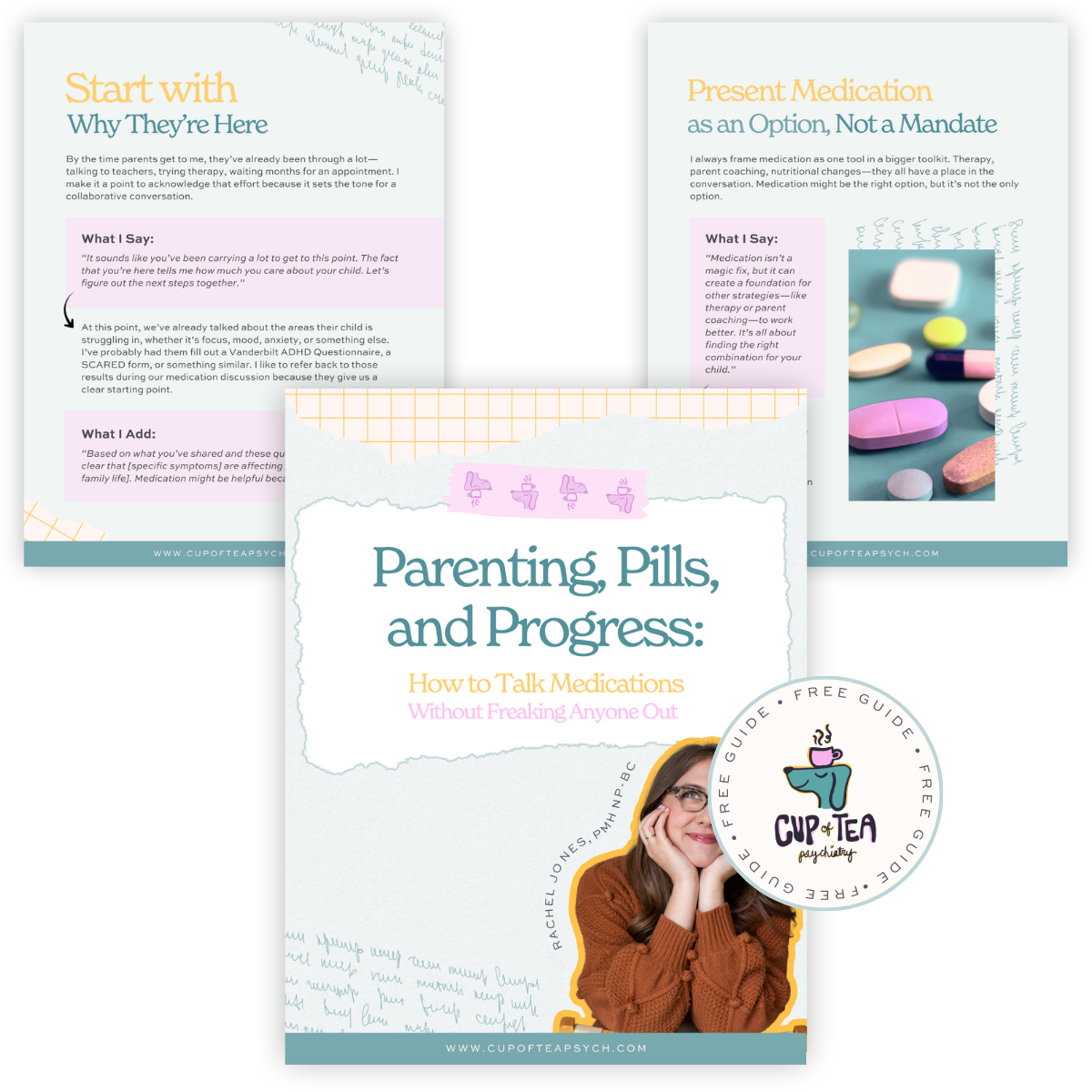
Parenting, Pills, and Progress
How to Talk Medications. Without Freaking Anyone Out
GET THE FREE GUIDEIf medication talks have been feeling harder than they should lately…
It’s not because you’re bad at explaining meds. And it’s not proof you’re pushing too fast.
Here’s what’s actually happening:
Most clinicians were never given a clear, practical framework for talking through risks, benefits, and options with families.
So we end up balancing parent fears, black box warnings, and symptom checklists on the fly.
This tip sheet gives you a calm, collaborative structure to follow in session.

- Build a Sustainable Psychiatric NP Practice for Free
- Build a Sustainable Psychiatric NP Practice for Free
- Build a Sustainable Psychiatric NP Practice for Free
- Build a Sustainable Psychiatric NP Practice for Free
- Build a Sustainable Psychiatric NP Practice for Free
- Build a Sustainable Psychiatric NP Practice for Free
- Build a Sustainable Psychiatric NP Practice for Free
Here’s what’s really holding you back:
Not your knowledge. Not your ability to connect with parents. It’s that medication conversations often turn into emotional juggling without a clear structure to follow.
You are validating and educating at the same time
You are trying to honor how hard families worked to get here while explaining options, symptoms, and next steps all in one conversation . Without a simple flow, it can feel tense instead of collaborative.
You are balancing benefits with side effects in real time
Focus, mood, anxiety, sleep, irritability, appetite changes, and activation risk can sound scary without context . Without clean language, parents hear danger instead of a plan.
Black box warnings can hijack the whole visit
Even when risks are rare, the wording can land like a threat. If you do not have a way to frame monitoring, safety, and follow up , the conversation can spiral into fear instead of clarity.
You were never given a practical script for meds
Most training focuses on dosing, not how to talk through it with anxious parents and a kid listening. So you end up relying on reassurance instead of a repeatable system .
Here’s what you’ll learn:
Clear, practical language to guide medication conversations without increasing fear or pressure.

How to frame medication as one tool, not a mandate
Language to validate parent effort, reference screening results, and explain why symptoms impact school, mood, or relationships. You will have a collaborative opening script .
How to discuss side effects and black box warnings calmly
Simple explanations that balance risks and benefits, include kids appropriately, and prevent fear from taking over the visit. Learn how to anchor safety and monitoring .
How to emphasize flexibility and ongoing follow up
Scripts to reassure families they are not locked in, compare treating versus not treating, and outline clear next steps. You will leave with a repeatable structure .

Welcome
I’m Rachel Jones, PMHNP
Founder & Community Host of The Psych NP Network
I started this network after more than a decade working across psychiatric settings, and noticing the same pattern over and over again.
The work is complex. The decisions matter. And too often, Psych NPs are expected to carry that weight alone.
What I’ve learned along the way:
What actually makes us better clinicians isn’t having all the answers. It’s having people we trust to think things through with.
This network was built as a cozy professional home for that kind of work: asking real questions, talking honestly about cases, and holding onto the heart of why we chose this field in the first place.
FOLLOW ME ON INSTAGRAM