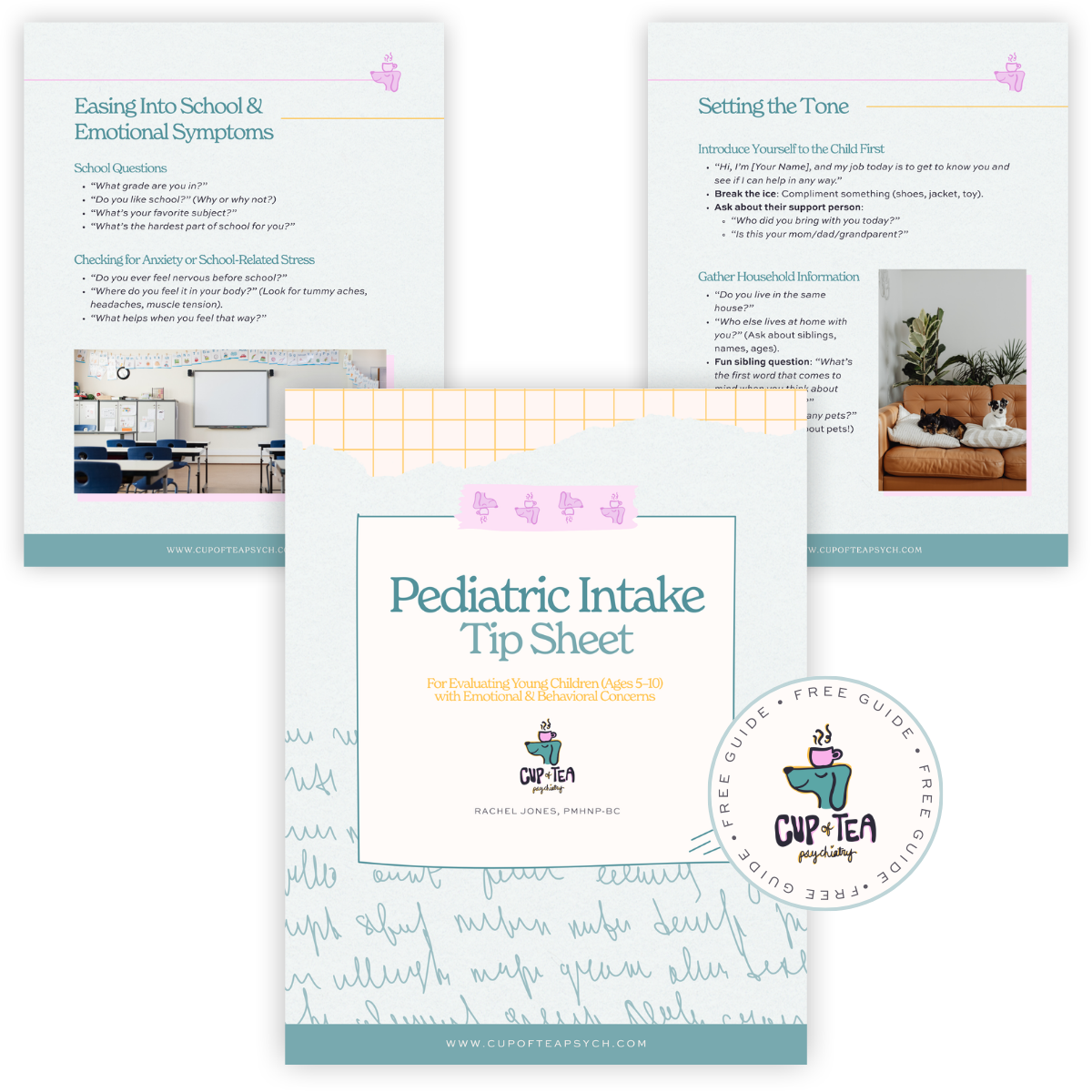
Pediatric Intake Tip Sheet
For Evaluating Young Children (Ages 5–10) with Emotional & Behavioral Concerns
GET THE FREE GUIDEIf pediatric intakes have been feeling harder than they should lately…
It’s not because you’re bad at working with kids. And it’s not proof you’re not ready to see them.
Here’s what’s actually happening:
Most clinicians were never given a clear, practical framework for evaluating emotional and behavioral concerns in ages 5 to 10.
So we end up winging it between rapport, parent pressure, and scattered screening questions.
This tip sheet gives you a clear, developmentally sound path to follow in session.

- Build a Sustainable Psychiatric NP Practice for Free
- Build a Sustainable Psychiatric NP Practice for Free
- Build a Sustainable Psychiatric NP Practice for Free
- Build a Sustainable Psychiatric NP Practice for Free
- Build a Sustainable Psychiatric NP Practice for Free
- Build a Sustainable Psychiatric NP Practice for Free
- Build a Sustainable Psychiatric NP Practice for Free
Here’s what’s really holding you back:
Not your compassion. Not your ability to connect with kids. It’s that pediatric evaluations often turn into mental juggling without a clear structure to follow.
You’re building rapport and assessing at the same time
You’re trying to engage a 7 year old while tracking symptoms, development, and parent dynamics all in one conversation . Without a simple flow, it can feel scattered instead of clinical.
You’re not sure what’s big feelings versus something deeper
Tantrums, anxiety, sensory struggles, ADHD, sleep issues, trauma exposure can look similar on the surface . Without targeted questions, it is easy to miss the pattern underneath.
Parent reports feel emotional and hard to organize
Caregivers often arrive overwhelmed, worried, or frustrated. If you do not have a way to map timing, triggers, and severity , the session can drift into story instead of clarity.
You were never given a practical intake framework
Most training focuses on diagnosis, not how to structure a real world visit with a dysregulated child in the room. So you end up relying on instinct instead of a repeatable system .
Here’s what you’ll learn:
Clear, practical steps to find a collaborating physician, without overcomplicating the process.

How to open the session and build fast rapport
Simple language to engage kids, gather home context, and ease into school and emotional concerns. You will have a clear starting flow .
How to assess tantrums, anxiety, and triggers clearly
Focused questions to map timing, frequency, severity, and common drivers like sleep or sensory stress. Learn how to separate child from behavior .
What to ask caregivers to uncover patterns
Prompts to clarify onset, triggers, and daily impact so the visit moves toward formulation, not scattered stories. You will leave with a reusable structure .

Welcome
I’m Rachel Jones, PMHNP
Founder & Community Host of The Psych NP Network
I started this network after more than a decade working across psychiatric settings, and noticing the same pattern over and over again.
The work is complex. The decisions matter. And too often, Psych NPs are expected to carry that weight alone.
What I’ve learned along the way:
What actually makes us better clinicians isn’t having all the answers. It’s having people we trust to think things through with.
This network was built as a cozy professional home for that kind of work: asking real questions, talking honestly about cases, and holding onto the heart of why we chose this field in the first place.
FOLLOW ME ON INSTAGRAM